Why Every Business Needs a Modern Website in 2026
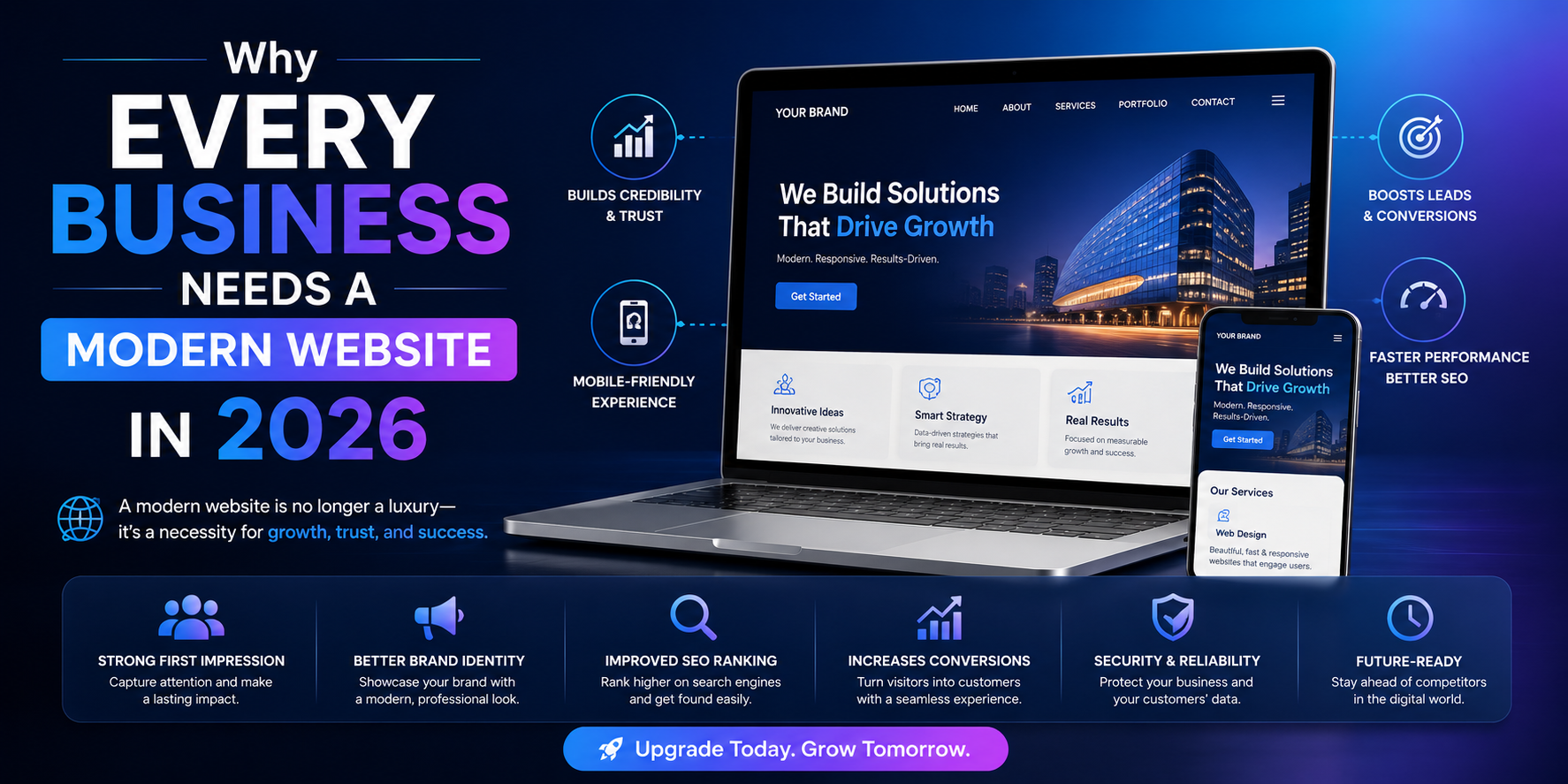
Think about the last time you searched for a business online and landed on a website that looked like it was frozen in 2014. Small fonts. Slow loading. Confusing navigation. Did you stay, or did you hit the back button and move to the next search result?
Most people choose the back button. And that single decision, made in a few seconds, decides whether a business gets a customer or loses one forever.
A website is not just a digital brochure anymore. It is the first handshake between your business and the world. In 2026, that handshake needs to feel confident, current, and credible. If it does not, your business is quietly losing opportunities every single day, even if you never see it happen.
What Makes a Website "Modern" in 2026
A modern website is not defined by how flashy it looks. It is defined by how well it works for the person using it.
A modern website today is fast on any device, easy to navigate without instructions, built to answer visitor questions before they have to ask, secure and trustworthy, and updated regularly with fresh, relevant content.
It also reflects your brand clearly the moment someone lands on it, without them needing to scroll to figure out what you actually do.
Here is a simple way to compare an outdated website with a modern one.
| What Changed | Outdated Website | Modern Website |
|---|---|---|
| Design | Cluttered, text heavy | Clean, visual hierarchy |
| Speed | Slow to load | Loads in seconds |
| Mobile experience | Hard to navigate on phones | Built mobile first |
| Content | Static, rarely updated | Fresh, regularly refreshed |
| Interaction | One way information | Chat support, forms, personalization |
| Trust signals | Missing or outdated | Reviews, certifications, case studies visible |
| Navigation | Confusing menus | Simple, intuitive paths |
Every row on that table represents a moment where a visitor either stays or leaves.
Why an Outdated Website Is Costing You More Than You Think
Here is something most business owners do not realize. An outdated website is not neutral. It is not just doing nothing. It is actively working against you.
When a visitor lands on a slow, cluttered, or confusing site, they do not think "maybe this business is just behind on updates." They think "this business is not serious" or "this business cannot be trusted." That judgment happens in seconds, and it happens before they read a single word about your products or services.
According to Google, more than half of mobile users abandon a site if it takes longer than three seconds to load. That means your website could be losing customers before your homepage even finishes appearing on their screen.
And it goes beyond speed. A well known Stanford University, study found that a majority of users judge a company's credibility almost entirely based on its website design. Not its products. Not its reviews. Its design. If your website looks dated, visitors assume your business is dated too, whether that is true or not.
The Real Perks of Having a Modern Website
Businesses that invest in a modern website are not just making a cosmetic upgrade. They are unlocking real, measurable advantages.
A modern website builds instant credibility. The moment someone lands on a clean, professional site, their guard drops a little. They are more willing to explore, more willing to trust, and more willing to take the next step.
It works around the clock. Your website does not take breaks, weekends, or holidays. It answers questions, showcases your work, and captures leads while you are asleep. It improves how easily people find you. A modern website is typically built with search visibility in mind from the ground up, using proper structure, fast loading pages, and mobile friendly design, all of which search engines reward with better rankings.
It gives you room to grow. A modern website is usually built on flexible platforms that can add features like booking systems, e-commerce, chatbots, or membership areas as your business grows, instead of requiring a full rebuild every time your needs change. It turns visitors into customers more consistently. Clear navigation, strong calls to action, and a smooth user journey mean fewer people give up halfway through and more people actually reach out, sign up, or buy.
Real World Proof: What a Website Refresh Can Do
Consider a small architecture firm that had relied for years on a basic, outdated website built by a relative's friend. It listed services and a phone number, nothing more. Inquiries were rare and mostly came through word of mouth.
After moving to a modern, mobile friendly website with a clear portfolio section, client testimonials, and a simple contact form, the firm began receiving a steady stream of inquiries directly through the site, something that had never happened before. The work itself had not changed. The way it was presented online had.
This pattern repeats across industries. A modern website does not replace good work or a good product. It makes sure that good work actually gets discovered by the people looking for it.
How to Build a Modern Website That Actually Works
Building a modern website is not about chasing trends. It is about making deliberate choices that serve your visitors and your business goals.
Start with a clear purpose. Before any design work begins, know what you want visitors to do on your site, whether that is calling you, filling out a form, or making a purchase. Every page should guide them toward that action.
Prioritize mobile first design. Since most web traffic now comes from phones, your website should be designed for a small screen first, then adapted for desktop, not the other way around.
Keep navigation simple. Visitors should be able to find what they need within a few clicks. If your menu has too many options, people get overwhelmed and leave.
Invest in speed. Compress images, choose reliable hosting, and avoid unnecessary heavy elements that slow down loading times.
Add trust signals. Client testimonials, certifications, case studies, and real photos of your work or team make your business feel human and credible.
Make it easy to update. Choose a platform that allows you to add blog posts, update service pages, or refresh content without needing a developer every time.
Plan for the long term. A modern website is not something you build once and forget. It should be reviewed and refreshed regularly to stay relevant as your business and your audience evolve.
Your Website Reflects Your Business, Whether You Intend It To or Not
Here is the honest truth. Whether you actively manage your website or not, it is already telling visitors something about your business. An outdated, slow, or confusing website tells them you are behind. A modern, fast, and clear website tells them you are current, capable, and worth their time.
The businesses growing fastest right now are not necessarily the ones with the biggest budgets. They are the ones who understood early that their website is not a one time expense. It is an ongoing investment that keeps paying back in trust, visibility, and customers.
The question is not whether your business needs a modern website. It already does. The real question is how much longer you are willing to let an outdated one hold you back.
