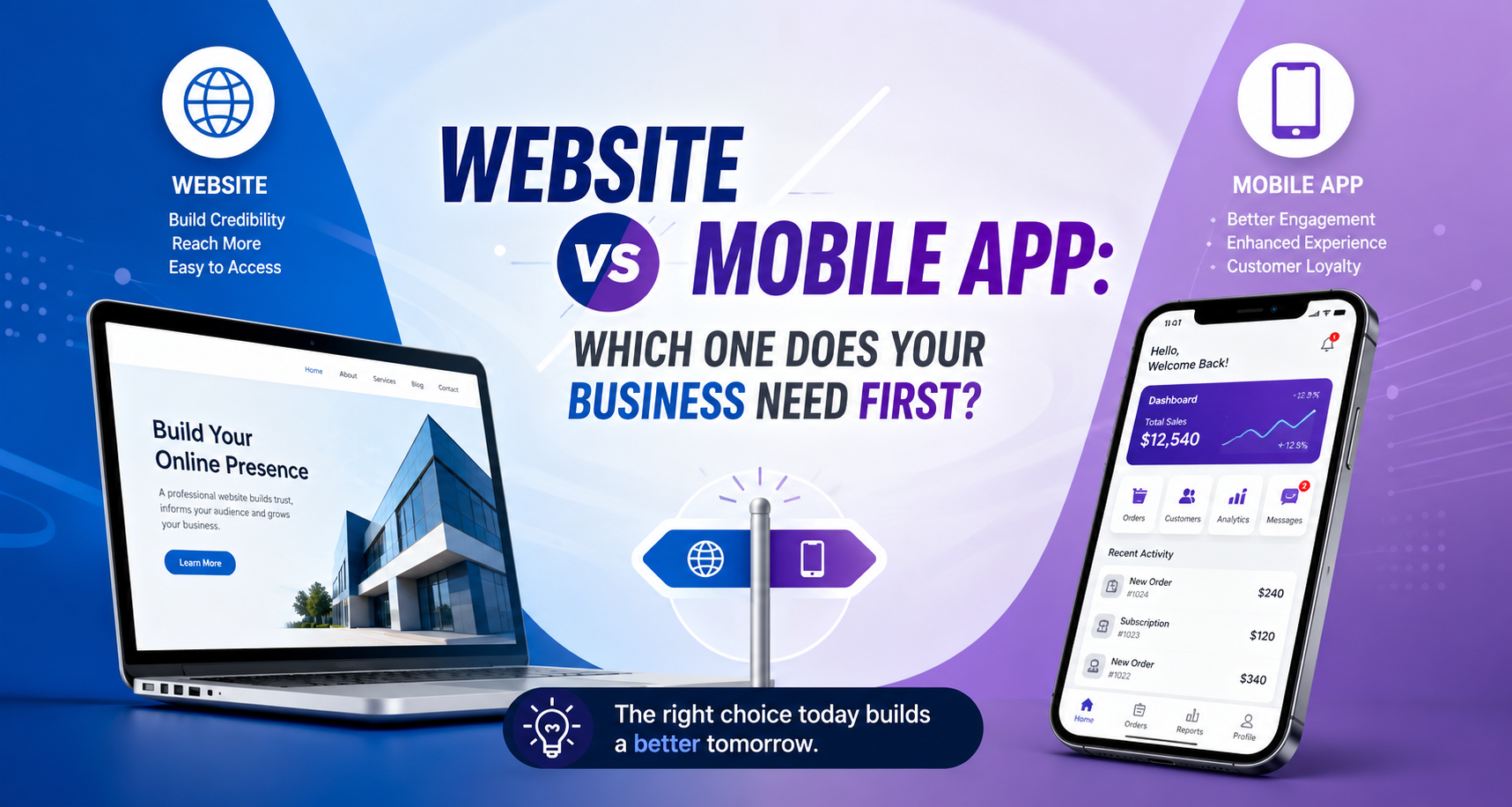
Website vs Mobile App: Which One Does Your Business Need First?
Every founder hits this moment eventually.
The business is growing. The digital presence needs to level up. And then comes the question that sounds simple but is actually not: do we build a website first or go straight to a mobile app?
Some people will tell you the answer is obvious. It is not. The right choice depends entirely on what your business does, who your customers are, and what problem you are actually trying to solve.
This blog will walk you through both options honestly, without pushing you toward the more expensive one.
Why This Decision Matters More Than People Realise
Choosing the wrong starting point does not just waste money. It wastes time, delays growth, and sometimes creates a product nobody actually uses. Getting this right early saves a lot of undoing later.
A website built when you needed an app means your customers have a frustrating experience on mobile and quietly switch to a competitor. An app built before you have established trust or traffic means you are spending significant money on something people have not yet found a reason to download.
First, Understand What Each One Actually Is
Before comparing the two, it helps to be clear about what they each do well. A website is accessible from any browser, on any device, without downloading anything.
It is your digital headquarters. It is where people go when they search for you on Google, when they want to know if you are legitimate, and when they are deciding whether to trust you. A mobile app lives on a user's phone.
They have to consciously choose to download it and keep it. In exchange for that commitment, an app can offer a richer, faster, more personalised experience. It can send notifications, work offline, and integrate with the phone's camera, GPS, and other features. Both are valuable.
The question is which one your business needs to exist first.
The Case for Building Your Website First
It is where customers look for you
According to BrightEdge, 53% of all website traffic comes from organic search. When someone hears about your brand for the first time, the first thing they do is search for it online. If there is no website, there is nothing to find. No website means no credibility and no first impression.
It builds trust before anything else
According to Stanford Web Credibility Research, 75% of users judge a company's credibility based on its website design alone. Before someone downloads your app, they need to believe your brand is worth trusting. A well-designed website does that job.
It is more cost-effective to start
A professional website typically costs significantly less to build and maintain than a mobile app. For early-stage brands, that budget difference can be redirected toward marketing, product development, or customer acquisition.
It is easier to update
Changing content, pricing, or messaging on a website takes hours. Updating an app requires development work, testing, and going through app store approval processes that can take days or weeks.
The Case for Building a Mobile App First
There are specific situations where building an app before or alongside a website makes complete sense.
When your product is the app
If your core service is something people need to do repeatedly, on the go, with a personalised experience, an app is not optional. It is the product. Think food delivery, fitness tracking, ride-hailing, or language learning. These experiences cannot be replicated well in a browser.
When your users are mobile-first
According to Statcounter, mobile devices account for over 60% of global web traffic in 2025. In markets like India, that number is even higher. If your audience is primarily engaging on smartphones, an app gives them a better, faster experience than a mobile browser ever will.
When retention matters more than discovery
Websites are better for discovery. Apps are better for retention. If your business model depends on customers coming back repeatedly, an app with push notifications and a personalised interface keeps them engaged far more effectively. According to Adjust's 2024 Mobile App Trends Report, app retention rates are 3 to 4 times higher than mobile web retention rates across most industries.
Side by Side: How They Compare Across Key Factors
| Factor | Website | Mobile App |
|---|---|---|
| Discovery and search visibility | Strong, indexed by Google | Limited, found only through app stores |
| Cost to build | Lower, typically starts at a fraction of app cos | Higher, requires separate iOS and Android builds |
| Trust and credibility | Established immediately | Requires prior awareness of the bran |
| User experience depth | Good on desktop, limited on mobile | Excellent, native device integration |
| Push notifications | Not possible | Available and highly effective |
| Offline functionality | Not available | Available depending on build |
| Consistent branding | Builds recognition and trust over time | Builds recognition and trust over time |
| Online reviews | Influences purchase decisions | Influences purchase decisions |
| Speed of updates | Fast, no approval process | Slower, requires app store review |
| Audience reach | Anyone with a browser | Only users who download the app |
| Best for | Discovery, information, first impressions | Engagement, retention, repeat usage |
Real Brands That Got the Sequence Right
The numbers here are worth paying attention to. According to App Annie's 2024 State of Mobile Report, the average smartphone user spends 4.8 hours per day on their phone, and 92% of that time is spent inside apps rather than browsers.
That sounds like a clear win for apps. But here is the context that matters. The top apps people use daily are messaging, social media, entertainment, and navigation. When it comes to discovering a new brand or researching a product, people still go to search engines and websites first.
According to Google, 63% of all shopping journeys now begin with an online search, not an app. The website captures the top of the funnel. The app deepens the relationship once trust is established.
Both have a role. The sequence is what matters.
What the Data Says About How People Actually Use Both
Zomato launched as a website first, building a restaurant database and audience through web search before investing in their mobile app. Once the user base was established online, the app became the primary experience. Today the app drives the majority of their orders, but the website laid the foundation.
Duolingo built its web platform first to validate demand and reach users across devices. The mobile app followed once they understood how users wanted to engage with the product. The app now has over 500 million downloads but it was the website that proved the concept.
A Mumbai-based interior design studio made the mistake of investing in an app before building any web presence. The app had fewer than 200 downloads in its first six months. They paused, built a well-optimised website, started a blog, and grew organic traffic to 15,000 monthly visitors within a year. The app is now being rebuilt with that audience in mind .Sequence is strategy.
The Hybrid Approach: When You Might Need Both Sooner Than You Think
Some businesses genuinely need both from the start. The key is knowing when that is actually true versus when it is just a nice idea.
You likely need both early if your business serves two different user groups with different needs. A marketplace platform, for example, might need a content-rich website for buyers discovering products and an app for sellers managing listings on the go.
You probably do not need both early if your primary goal is lead generation, brand awareness, or selling a service. Start with the website. Build traffic. Understand your customers. Then build the app with that knowledge.
Trying to do both at once without enough budget or team capacity often results in two mediocre products instead of one excellent one.
How to Make the Decision For Your Business
Here are the four questions worth answering honestly before you decide:
Where do your customers currently find you? If they are searching Google, start with a website. If they are already using apps in your category daily, an app may deserve priority.
How often will they use your product? One-time or occasional interactions suit websites. Daily or frequent interactions suit apps.
What is your budget? A strong website can be built for a fraction of the cost of a well-built app. If budget is a constraint, the website protects your investment better at the start.
What does your customer journey look like? Map out how someone discovers you, decides to trust you, and then becomes a loyal customer. Whatever stage has the biggest friction is where you should invest first.
The Short Answer
If you are just starting out or establishing your digital presence, build the website first.
It makes you discoverable. It makes you credible. It gives you a foundation to understand your audience before you invest in a more complex, more expensive product.
Once your website is working, once people are finding you, trusting you, and buying from you, then build the app that deepens that relationship.
One strong product beats two average ones every time.
